

I help women come home to themselves.
And I know what that takes.Therapist. Somatic practitioner. Retreat leader. Nervous system nerd. Woman who crashed — and came back. Not because I figured it all out. Because I finally stopped running from what my body had been trying to tell me for years.
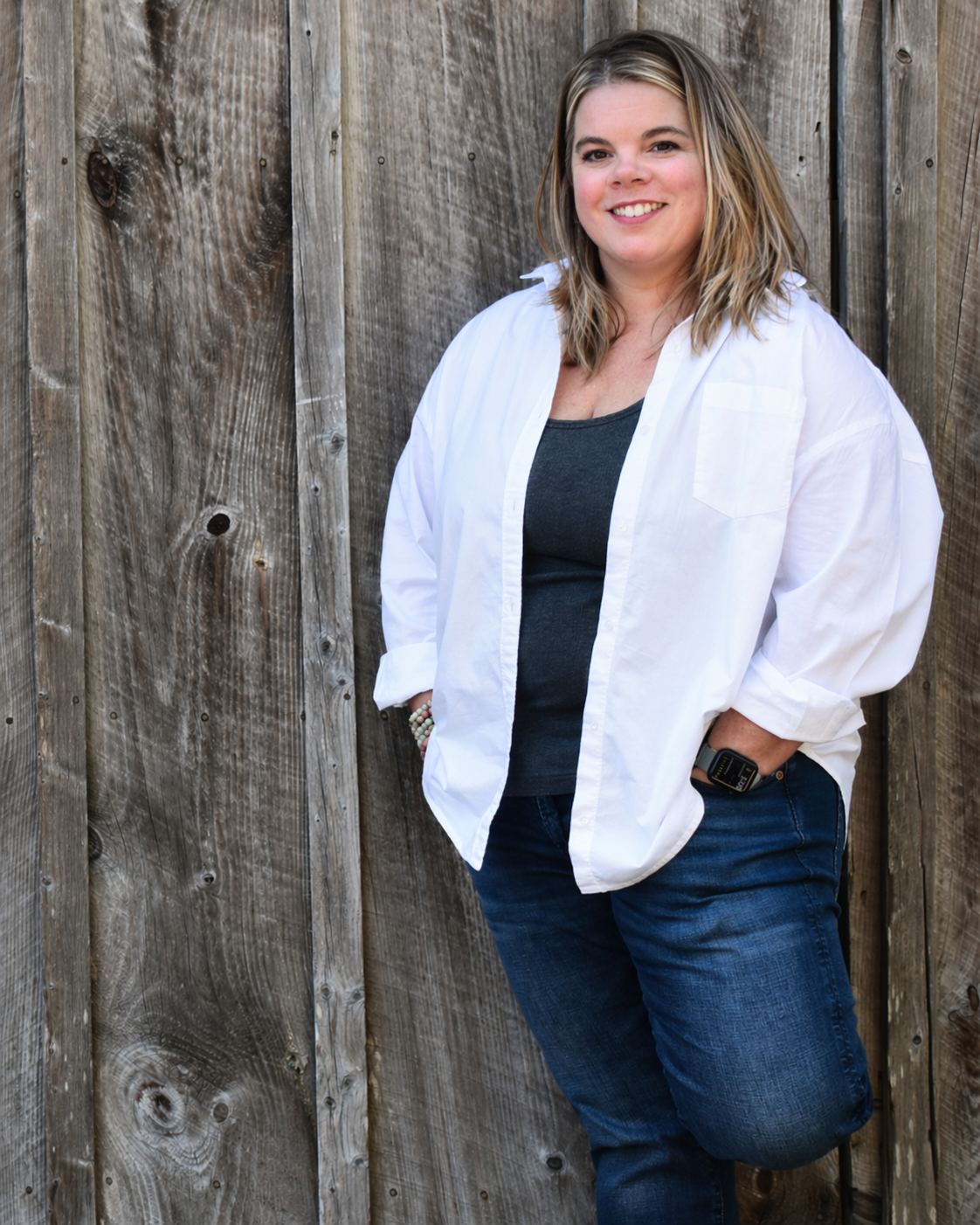
for other people's hardest moments.
This is what I learned.
I'm a Licensed Independent Clinical Social Worker with over two decades in mental health — but that's not really the part that matters most on this page.
What matters is that I know what it costs to be the strong one. The capable one. The one who figures it out, shows up, holds it together — while quietly losing the thread of herself.
I know it because I lived it. For years. And then my body made sure I couldn't ignore it anymore.
I'm a therapist, a somatic practitioner, a retreat leader, a yoga teacher, an intuitive coach — and a woman who has spent the last several years putting herself back together from the inside out. Not as a metaphor. Literally.
Everything I teach, I practice. Everything I offer, I've needed. That's not a marketing line — it's the only reason any of this works.
leaves a mark.
I said that to my daughter Marley once — at a lunch table, after overhearing a stranger casually mention that her therapist had collapsed and nearly died of a heart attack. "She's a psychotherapist," the woman added.
I turned to Marley and said: "See — carrying it all leaves a mark."
She nodded. She didn't ask what I meant. She already knew — because she'd been there for the parts I couldn't hide.
This is my story.It was June 5th, 2021. A Monday morning. 97 degrees.
My Apple Watch said 42 BPM. I tried to take my own pulse and couldn't find it. I was sitting on the couch, silently freaking out, trying not to alarm anyone — because that's what I do. My husband brought Marley to school for the last week of 6th grade and came back. He was annoyed. Not without concern — but more annoyed. "What do you want to do?" he asked.
"I think I should go to the hospital."
I crawled up the stairs to get dressed. Walking was too hard.
I called my doctor's office from the car. The nurse said I sounded fine and suggested urgent care. When we got there, I could barely walk from the parking lot — I was that out of breath. The woman at the front desk wouldn't let me sit. I had to fill out paperwork. She took her time. Eventually a very pregnant nurse came out with a wheelchair and asked if I could walk or needed a ride. I felt bad — I thought I should be pushing her. But the ego had dissolved by then. I took the ride.
When they got me into the back, my heart rate was 33.
They had already called an ambulance. They were watching me move from a first-degree heart block, to second-degree, to what was likely becoming a full heart block.
The ambulance was already on its way.
We started across the city. My heart rate dropped. Tunnel vision. The walls closing in. I heard the EMT say: "Lights, please." And then lights and sirens, picking up speed across the city on a 97-degree Monday morning.
I was in the hospital for a week. Overnight, my heart rate dropped into the 20s. They put me on drips I reacted to. They eventually "stabilized" me at 34 BPM. Tuesday morning, the cardiologist came back. The routine heart catheterization became something else. As I was signing the consent form, he took my hand.
"Here's the thing," he said, matter-of-factly. "I live 20 minutes away. If I don't do this now, there's a good chance you'll code overnight and I won't make it here in time to save you."
I was 44 years old. Marley was finishing 6th grade.
Insurance had denied the MRI they wanted. So they placed a permanent pacemaker instead. It would beat my heart for me — because I had almost no electrical signal between the left side of my atria and ventricle. "Six weeks," they said, "and then back to normal."
They didn't know that normal had meant handstands. That normal meant snowboarding, running, the kind of movement where you risk a fall. All of that was gone now. My new normal had a maximum heart rate. My new normal was designed for someone 40 years older.
I am, according to every provider who has seen my case, a complete anomaly. Nothing that happened to me was caused by anything I did. My body just — did this. And kept doing it.
In January 2023, a lead in my pacemaker fractured. The device keeping my heart in rhythm had broken. We didn't know what was happening at first — the episodes looked like seizures, like strokes, like maybe I hadn't eaten enough. The ambulance crew wasn't sure.
Marley was 14. She curled up on the bed next to me, quietly crying. She didn't know if the thing keeping her mother alive had broken.
It had.
In January 2025, I finally got that MRI — the one insurance had denied in 2021. It showed chronic inflammation. Cardiac sarcoidosis. Trips to Boston. Cardiac experts. PET scans to test for cancer. Prednisone that sent me back into an ambulance with dangerous heart rhythms. More medications. Cancer medications. Menopause hitting at the same time the treatment started — and me losing half my hair and gaining 80 pounds from the medication weight.
In May 2025, two weeks after meeting a new cardiologist in Boston, they upgraded my device from a pacemaker to a pacer-defibrillator. Two weeks from first appointment to surgery. The speed at which they moved said everything. My heart had started trying to beat on its own — and they were worried it would beat too fast and I'd go into cardiac arrest.
Through all of it — the bone-deep exhaustion, the body I no longer recognized in the mirror, the grief of everything that fell apart — I was still trying to show up for everyone else.
That's what women like us do. Until we can't anymore.
in those five years.
And I'm still here.
The last year has been learning to trust my body again. Every time my heart rate climbs near 150 — even just from a brisk walk or an emotion that surfaces quickly — my nervous system sends a signal that used to mean danger. My body learned that lesson for good reason. Now we're unlearning it together.
I know what it is to practice what you teach when the stakes are your actual life. To use the somatic reset when you're in the back of an ambulance. To regulate your nervous system when your body has become genuinely unpredictable. To choose embodiment when disembodiment feels like the only safe option.
I didn't come back by thinking my way through it. I came back the same way I teach — one breath, one practice, one moment of coming home at a time.
How do I know I'm back? Here's what I notice:
Marley is named after Bob Marley — in the belief that we can transcend our differences and come together. One love. She has been my witness through the hardest parts of this journey. And she has watched me come back.
This work isn't theory. It's what brought me home.
Training & Credentials
- Licensed Independent Clinical Social Worker (LICSW)
- 25+ years in mental health and healing
- Somatic Experiencing practitioner
- Registered Yoga Teacher (RYT)
- Nervous system regulation specialist
- Retreat leader — 13+ years
- Intuitive coach and card reader
- Burnout recovery and embodiment specialist
What I Offer
- Free Somatic Reset — Come Home
- The Aligned Woman — private audio retreat ($37)
- Rooted: A Sacred Sisterhood — 6-month community
- From Output to Embodiment — CEU training for therapists
- Intuitive Readings — private sessions
- 1:1 Somatic Coaching — by relationship and application
- Retreats — NH and Vermont
- Weekly yoga — New Boston, NH
Your body already knows the way.
The free Somatic Reset is 15 minutes. It's a good place to start — and your nervous system will tell you what comes next.